
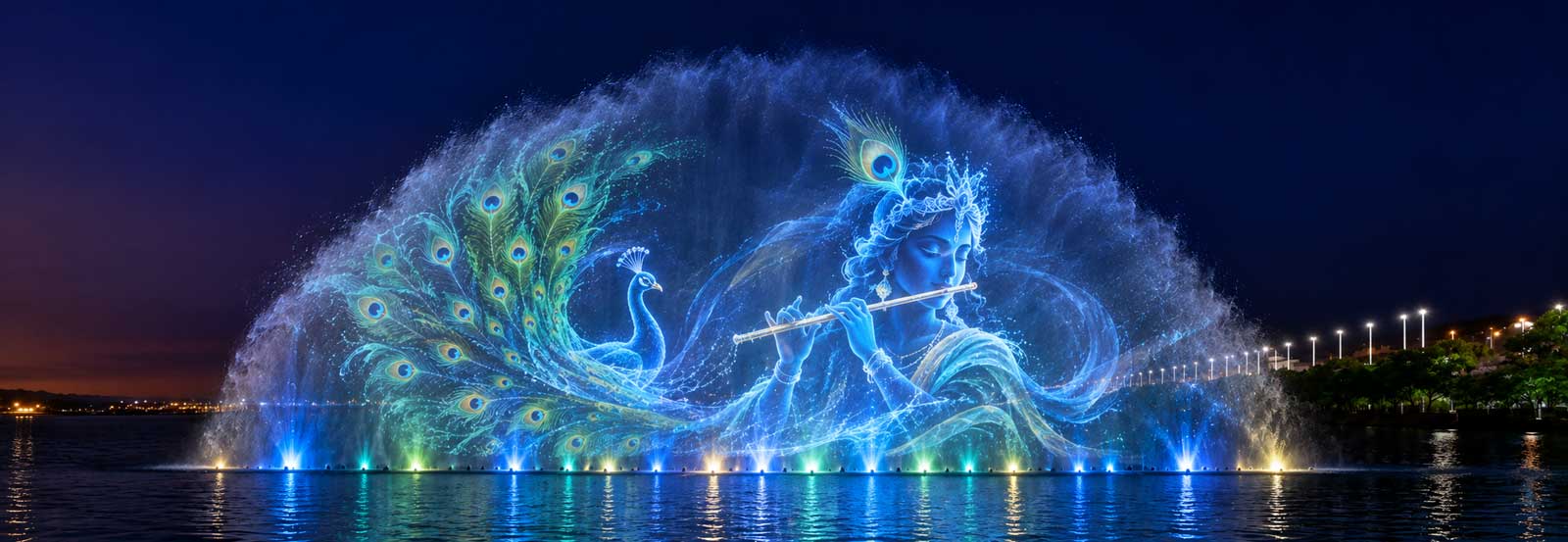
What if a screen did not have to be made of glass, LED panels or fabric?
Imagine watching a story unfold on a shimmering wall of water, images appearing seemingly in mid-air, surrounded by light, sound and movement. This is the visual possibility created by water screen projection, a technology that is changing how audiences experience large-scale shows and events.
By combining precisely controlled water, high-performance projection, lighting, sound and creative content, a water screen can become much more than a display surface. It can become a storytelling medium.
As brands, governments, cultural institutions, entertainment destinations and event organisers look for more memorable ways to engage audiences, water screen projection services are emerging as an increasingly compelling solution.
Water screen projection is an immersive visual technology in which specially engineered water droplets form a fine, stable screen onto which digital content is projected.
Unlike a conventional projection screen, the image appears to float within the environment. The translucent nature of the water creates a distinctive visual effect, particularly in low-light or nighttime settings.
A typical water screen projection show can integrate:
When these elements are synchronised, water becomes the canvas for a large-scale audiovisual experience.
Traditional displays are designed to present content on a fixed surface. Water screen projection changes that relationship. The screen itself is part of the visual experience.
Because the projected image interacts with a translucent, moving surface, it can create an illusion of depth and suspension. Content can appear to emerge from the water, move across it or blend into the surrounding environment.
This makes water screen projection for events particularly effective when the objective is to create spectacle rather than simply display information.
The evolution of event technology has moved beyond simply putting larger images in front of an audience.
Today, audiences increasingly expect experiences that are:
Water screen projection fits naturally into this shift.
Instead of treating technology as a background element, the projection becomes part of the performance itself.
A product can be introduced through a visual story. A historical narrative can unfold across a water screen. A cultural performance can be enhanced with animated visuals. A landmark can become the backdrop for a large-scale multimedia presentation.
Creating a successful water screen projection involves considerably more than pointing a projector at water.
Specialised nozzles and pumps generate a fine, consistent curtain of water. The water needs to be distributed evenly to create a suitable surface for projection.
The dimensions and configuration of the water screen depend on the venue, viewing distance and creative requirements.
Content is created specifically for the projection environment.
Animations, motion graphics, video sequences and visual effects need to be designed with the water screen’s dimensions and characteristics in mind.
Content that works well on an LED wall may require a different approach when projected onto water.
High-performance projectors deliver the visual content onto the water curtain. Brightness, contrast, projection distance and environmental lighting all influence the final result.
Music and sound effects can be synchronised with the visuals to create a stronger emotional impact. For large-scale productions, show-control systems can coordinate multiple technologies and cues with precision.
Water screen projection does not have to exist independently.
It can be combined with:
This creates opportunities for increasingly sophisticated immersive visual experiences.
One of the biggest advantages of water screen projection is the distinctive visual character it brings to an event.
A conventional projection screen provides a stable, opaque surface. A water screen is translucent and atmospheric.
This difference can create visual effects where content appears to float, dissolve or emerge within the environment. The choice between the two depends on the project.
Traditional projection may be ideal when clarity, detailed visuals and controlled indoor environments are priorities. Water screen projection can be particularly effective when the goal is spectacle, atmosphere and an unconventional visual canvas.
The versatility of this technology makes it suitable for a wide range of applications.
Water screen shows can help communicate historical, cultural or civic stories in a visually engaging format.
Large-scale public installations can combine narration, animation, music and projection to create experiences designed for large audiences.
Historic sites and landmarks can become storytelling environments after dark.
Instead of simply illuminating a monument, a water screen projection show can introduce moving narratives, archival imagery, animation and cultural content.
For product launches, corporate celebrations and brand events, water screen projection can create a distinctive centrepiece.
Brands can use the technology to introduce campaigns, tell their origin stories or create dramatic product reveals.
Water screen projection is particularly suited to entertainment environments where audiences are already expecting spectacle.
It can become part of a recurring nighttime show or a larger multimedia attraction.
Festivals and celebrations often require visual experiences that can engage large audiences from considerable viewing distances.
A strategically designed water screen can provide a dramatic focal point while integrating seamlessly with music, lighting and live performances.
Technology alone does not create an unforgettable experience. The most effective water screen projection shows begin with a strong creative idea.
What should the audience feel?
What story needs to be told?
What visual moments should they remember?
These questions determine everything from the content and music to the projection scale and sequencing.
For a cultural show, the narrative might move through history. For a corporate event, it could follow a brand’s evolution. For a tourism experience, it could bring local legends and heritage to life.
The technology becomes the medium through which the story is experienced.
One of the most exciting possibilities is combining water screen projection and projection mapping.
Projection mapping allows digital content to be mapped onto architectural surfaces, buildings and physical structures. A water screen introduces another dynamic projection surface into the environment.
Together, they can create layered visual experiences in which content moves between architecture, water and surrounding surfaces.
This approach can transform an ordinary event space into a fully choreographed visual environment.
The event and entertainment landscape is increasingly focused on experiences rather than conventional displays.
Audiences are surrounded by screens every day. Simply placing another screen at an event may not create the desired sense of wonder.
Water screen projection offers a different kind of visual language.
It combines a familiar medium—digital imagery—with an unexpected surface: water.
That contrast is what makes the experience visually distinctive.
A successful water screen projection show depends heavily on the environment in which it is presented.
Factors such as:
need to be considered during planning and execution.
This is why professional water screen projection services involve both creative planning and technical expertise.
The objective is not simply to project content onto water, but to design the complete experience around the venue and audience.
As experiential technology continues to evolve, the boundaries between physical environments and digital content are becoming increasingly fluid.
Water can become a screen. A building can become a canvas. Light can become part of a story. And an entire public space can become a stage.
Future water screen projection experiences are likely to become increasingly integrated with real-time content, interactive technology, advanced lighting, projection mapping and other immersive systems.
The opportunity lies not in choosing one technology over another, but in understanding how multiple technologies can work together to create a cohesive experience.
At Showman, we approach visual technology as a storytelling tool.
Our experiential solutions bring together creative content, projection technology, lighting and large-scale production to transform spaces and engage audiences.
From water screen projection and projection mapping to laser shows, holographic projection and multimedia experiences, the focus is on creating experiences that are visually powerful and purpose-driven.
Because sometimes, the most memorable screen is not a screen at all.
It is water, light, motion and a story coming together at exactly the right moment.
What is water screen projection?
Water screen projection is a projection technology that uses a fine curtain of water as a surface for displaying digital images, videos and animations.
How does water screen projection work?
Specialised pumps and nozzles create a controlled water curtain. High-performance projectors then project specially designed visual content onto the water surface.
Where is water screen projection used?
It can be used for government events, cultural shows, festivals, corporate events, product launches, theme parks, resorts, tourism experiences and large-scale public installations.
Can water screen projection be combined with projection mapping?
Yes. Water screen projection can be integrated with projection mapping, lighting, lasers, musical fountains and other experiential technologies to create larger multimedia shows.
Is water screen projection suitable for outdoor events?
Yes, water screen projection can be designed for outdoor environments. However, factors such as ambient light, wind, water conditions, viewing distance and venue infrastructure need to be assessed during planning.
Why choose water screen projection for an event?
Water screen projection provides an unconventional visual surface and can create a distinctive combination of imagery, water, light and sound. It is particularly effective when an event requires a strong visual centrepiece or immersive storytelling experience.


