
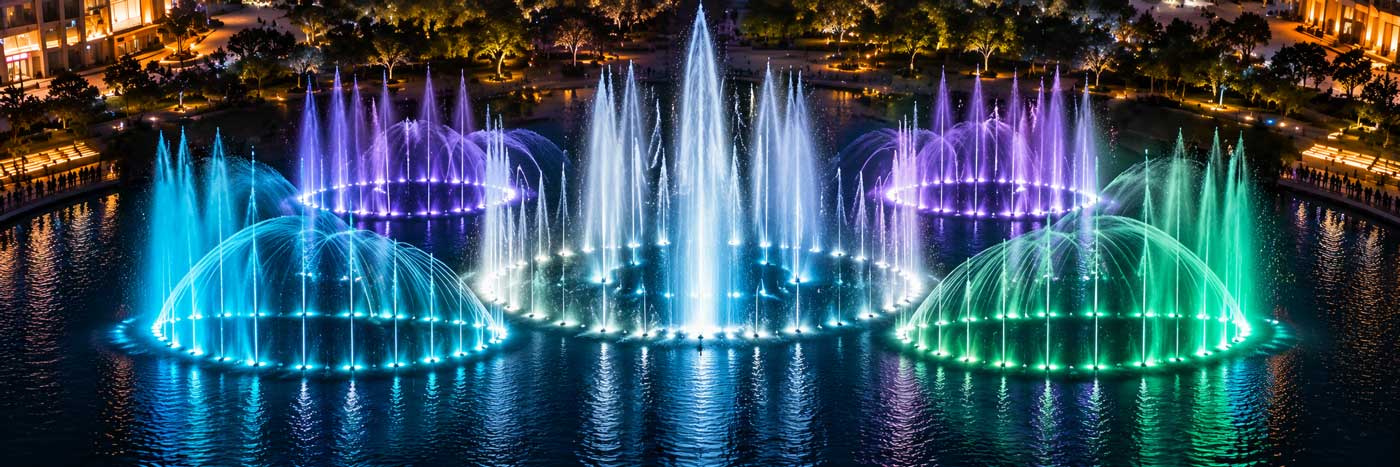
Water has always been a powerful element in architecture, landscaping and public spaces. From elegant garden fountains to large-scale musical fountain shows, the way water is used has evolved significantly with technology.
While traditional water features are primarily designed to add beauty, ambience and movement to a space, a musical fountain takes the experience several steps further by combining water, lighting, music and programmed movement into a coordinated visual spectacle.
But what exactly sets a musical fountain apart from a traditional water feature?
Let’s explore the key differences.
Traditional water features are designed mainly to enhance the visual appeal and atmosphere of a location. They can include decorative fountains, cascading waterfalls, ponds, streams and ornamental water installations.
Their design usually focuses on:
The water movement may be static or follow a predetermined pattern, but it generally does not respond to music or operate as part of a larger multimedia production.
Traditional water features are commonly found in gardens, hotels, residential developments, commercial spaces, parks and public areas.
A musical fountain is an advanced water installation where water movement is precisely programmed and synchronised with music and lighting.
Instead of functioning simply as a decorative element, the fountain becomes part of an entertainment or experiential installation.
Depending on the design, a musical fountain can combine:
The result is an experience where water appears to move in rhythm with the music while lighting changes enhance the choreography.
The biggest difference lies in how the water is experienced.
| Feature | Traditional Water Feature | Musical Fountain |
| Primary purpose | Decoration and ambience | Entertainment and immersive experience |
| Water movement | Mostly fixed or continuous | Programmable and choreographed |
| Music synchronisation | Usually absent | Central to the experience |
| Lighting | Basic or decorative | Dynamic and synchronised |
| Control system | Relatively simple | Advanced automated control |
| Programming | Limited | Highly programmable |
| Storytelling | Minimal | Can support themed storytelling |
| Audience engagement | Passive | Interactive or immersive |
| Event suitability | Moderate | High |
| Visual spectacle | Low to moderate | High |
A traditional fountain may have a beautiful and carefully designed water pattern, but the movement generally remains consistent.
A musical fountain, on the other hand, can have dozens or even hundreds of individually controlled water effects, depending on the scale of the installation.
Different nozzles can create different patterns, heights and movements. These can then be programmed to change at specific moments in a soundtrack.
The result is choreography—not simply flowing water.
Music is one of the defining elements of a musical fountain show.
The fountain can be programmed to respond to changes in rhythm, tempo and intensity. A slow musical passage might be paired with gentle water movements, while a dramatic section can introduce higher jets, rapid sequences and dynamic lighting.
This allows a musical fountain to become part of a larger narrative.
For events, attractions and public installations, carefully selected music can also help establish an emotional connection with the audience.
Lighting can transform a water feature after sunset, but the role of lighting in a musical fountain is much more dynamic.
Modern fountain shows can use programmable lighting to highlight:
When water and lighting are synchronised, the audience doesn’t simply see illuminated water—they experience a coordinated visual performance.
One of the biggest technological differences between the two is the control system.
Traditional fountains can operate using relatively straightforward pumps, valves and timers.
A musical fountain requires significantly more coordination.
The control system may manage:
This allows the entire installation to operate as a programmed performance rather than an independent water feature.
A traditional water feature primarily contributes to the atmosphere of a location.
A musical fountain can contribute to its story.
For example, a themed fountain show can use different combinations of water, light and music to represent a cultural story, historical event, brand identity or celebration.
This makes musical fountains particularly effective for destinations where the objective is to create a memorable visitor experience.
Musical fountains can be designed for a wide variety of applications, including:
Musical fountains can become major attractions within theme parks, resorts and entertainment destinations, providing scheduled performances that encourage visitors to gather and engage with the space.
Large-scale fountain installations can transform plazas, waterfronts, parks and urban spaces into destinations in their own right.
Hotels and resorts can use musical fountains as signature visual attractions, particularly in outdoor entertainment areas and entrance zones.
For product launches, cultural programmes, government events and large-scale celebrations, a musical fountain can serve as a dramatic centrepiece.
When designed as a permanent attraction, a musical fountain can become an important part of a destination’s identity and visitor experience.
In some cases, yes—but it depends on the existing infrastructure.
Factors such as the fountain basin, plumbing, pump capacity, nozzle configuration, electrical systems and available control infrastructure all need to be evaluated.
A professional assessment can determine whether an existing fountain can be upgraded with programmable water effects, lighting, audio and automation or whether a new system would be more practical.
The right option depends on the purpose of the installation.
A traditional water feature may be the better choice when the primary objective is to enhance landscaping, architecture or ambience.
A musical fountain is better suited when the objective is to create an attraction, entertain an audience or deliver a memorable visual experience.
If the fountain needs to support music, lighting, storytelling and scheduled performances, a programmable musical fountain offers significantly greater creative possibilities.
A successful musical fountain is not simply a collection of pumps, lights and water nozzles.
It requires the integration of hydraulic engineering, lighting design, audio, automation, programming and creative direction.
The choreography needs to be planned carefully so that the water movement, music and lighting work together rather than appearing as separate elements.
This is where experience in experiential technology becomes important.
At Showman, water can become more than a decorative element—it can become part of a larger visual experience.
Our approach to experiential installations combines technology, creative storytelling and precise execution to create large-scale audience experiences. Musical fountains can also be integrated with other technologies such as projection mapping, laser shows, lighting and multimedia content, depending on the requirements of the project.
The objective is simple: transform a physical space into an experience that people remember.
The evolution of fountain technology is moving beyond traditional decorative installations.
With programmable systems, advanced lighting, automation and multimedia integration, modern musical fountain shows can become immersive attractions capable of entertaining audiences and communicating stories.
The difference between a traditional water feature and a musical fountain ultimately comes down to purpose, technology and experience.
A traditional fountain adds beauty to a space.
A musical fountain can make the space come alive.
What is the difference between a musical fountain and a traditional fountain?
A traditional fountain is primarily designed for decoration and ambience, while a musical fountain combines programmable water movement with music, lighting and choreography to create an entertainment experience.
How does a musical fountain work?
A musical fountain uses pumps, valves, programmable nozzles, lighting systems, audio and control software to coordinate water, light and music according to a programmed sequence.
Are musical fountains suitable for outdoor events?
Yes. Musical fountains can be designed for outdoor events, public spaces, resorts, theme parks, celebrations and permanent installations, subject to appropriate site and infrastructure requirements.
Can musical fountains include projection mapping or laser shows?
Yes. Depending on the project design, musical fountains can be integrated with projection mapping, laser shows, lighting and other multimedia technologies to create a larger immersive experience.
What makes a musical fountain a good attraction?
The combination of movement, music, light and visual storytelling gives musical fountains strong audience appeal. When professionally designed and choreographed, they can become memorable attractions and destination experiences.


