
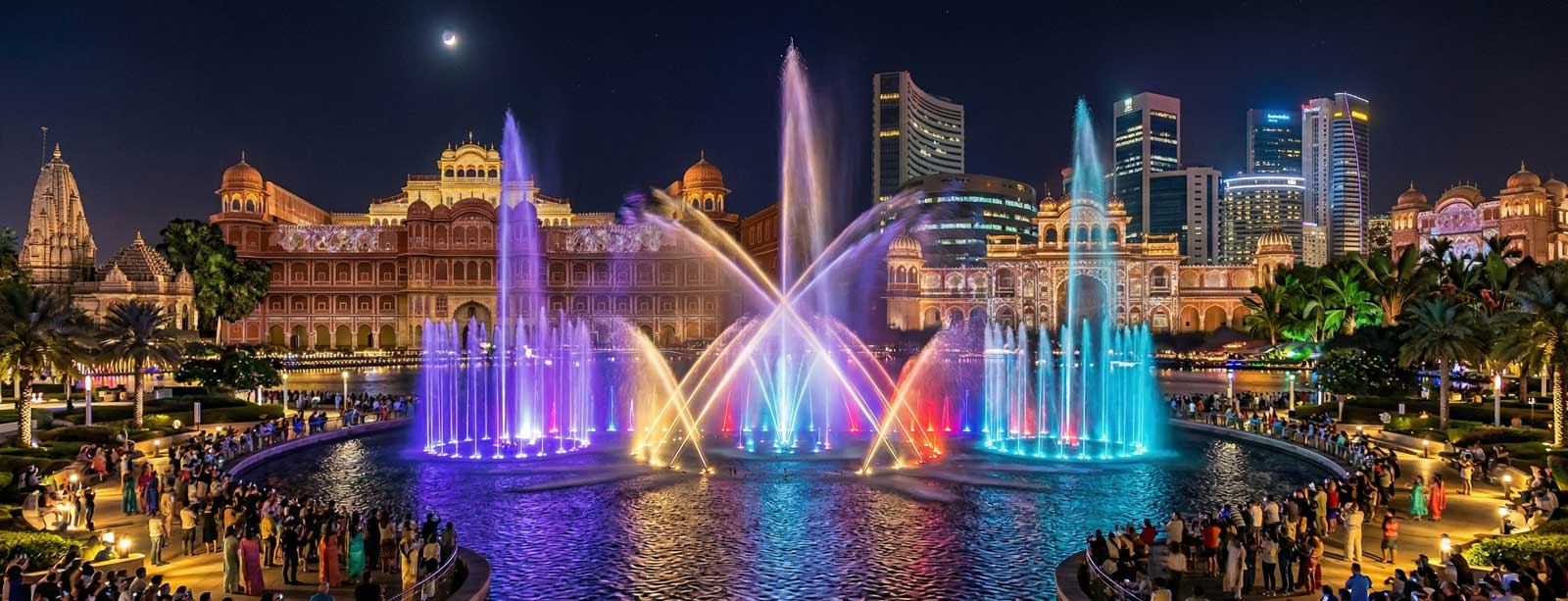
When developers or city planners evaluate a musical fountain, the question isn’t what it is. it’s whether the installation will justify the capital, sustain audience interest, and become a repeat-visit attraction.
The difference between a fountain that becomes a landmark and one that fades into the background comes down to design intelligence, technology integration, and long-term programming strategy.
A musical fountain is typically deployed to solve one (or more) of these:
If these outcomes are not defined upfront, the installation risks becoming a static asset with limited engagement value.
1. Choreography Depth (Not Just Jet Count)
More jets don’t automatically translate to a better show. The real differentiator is:
Fountains that evolve across multiple sequences (day/night, weekday/weekend, seasonal themes) consistently outperform one-loop shows.
2. Synchronisation Precision
The most common failure in mid-tier installations is poor sync between:
Millisecond-level control using advanced PLC/DMX systems is non-negotiable for a premium outcome and we at Showman, exactly have these checkpoints. Even minor lag breaks immersion.
3. Integration with Complementary Technologies
Standalone fountains have limited scalability in experience design. High-impact projects integrate:
This layered approach significantly increases perceived value without proportionally increasing footprint. Based on your event, Showman Entertainment would suggest options that you could go with for your project.
4. Site-Specific Design
A fountain designed without factoring site conditions underperforms. Key variables include:
Customisation at this level directly impacts visibility, safety, and consistency of the show. We have experience installing water projections at various geographies and weather conditions, and hence our experience would be a great add on for you while setting up the project with our experts.
Buyers often optimise for initial cost per square foot, but high-performing installations are evaluated on:
A lower upfront investment with limited programmability typically leads to faster audience fatigue and lower ROI.
A musical fountain is not a one-time installation, it’s a programmable media asset.
Projects that succeed long-term:
Without this layer, even technically advanced fountains lose repeat audience interest within months.
Urban & Government Projects
These projects benefit from scale and public accessibility.
Commercial Developments
Here, the fountain acts as a footfall anchor, directly influencing revenue ecosystems.
Hospitality & Premium Real Estate
Used strategically, fountains elevate perceived asset value and brand positioning.
Each of these directly impacts lifecycle performance.
Showman’s execution model is built around experience engineering, not just installation:
The focus is on delivering installations that remain relevant, programmable, and commercially viable over time.
The decision is not about installing a fountain. It’s about building an experience that people return to. Contact us to get a free quote.


