
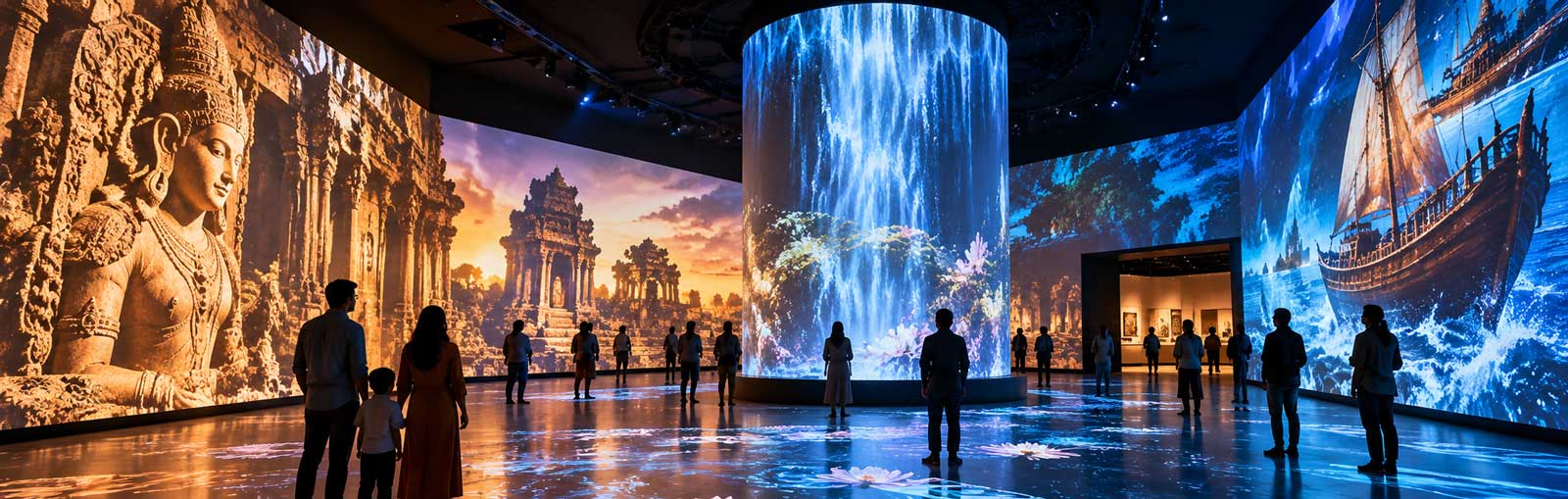
Museums have traditionally been spaces where visitors observe art, artefacts and historical objects from a distance. But as technology continues to reshape the way audiences interact with stories, museums are evolving from spaces of observation into spaces of experience.
Immersive projection technology is at the centre of this transformation. By combining projection mapping, 360-degree projection, spatial audio, laser visuals, motion graphics and interactive elements, museums can create environments where art and history extend beyond the traditional frame.
Instead of simply looking at an artwork, visitors can step inside its story.
Traditional museum displays rely heavily on physical objects, information panels and carefully curated lighting. While these remain essential, digital technology provides new ways to add context and emotion to an exhibition.
With projection mapping for museums, walls, floors, ceilings and architectural surfaces can become dynamic canvases. Historical photographs can move across walls, paintings can transition through different artistic stages, and architectural details can be highlighted through precisely mapped visuals.
This allows museums to build narratives around their collections rather than presenting individual objects in isolation.
For example, an exhibition about an ancient civilisation could use large-scale projections to recreate its architecture, landscapes and cultural environment. Visitors could experience how a historical site may have looked while simultaneously hearing contextual narration and ambient sound.
One of the most powerful developments in immersive exhibitions is 360-degree projection.
Rather than restricting visuals to a single screen, projection systems can cover multiple surfaces around the audience. Walls, floors and ceilings work together to create a continuous visual environment.
This approach can be particularly effective for:
The visitor is no longer simply facing a display. The content surrounds them, creating a stronger sense of presence and spatial immersion.
A painting captures a moment within a frame. Immersive technology can expand that moment into an entire environment.
Through motion graphics and projection mapping, selected elements within an artwork can be animated or visually extended. Landscapes can appear to move, atmospheric elements can evolve, and visual transitions can connect one artwork to another.
This does not replace the original artwork. Instead, it can provide an additional interpretive layer that helps audiences understand the artist’s world, influences and creative process.
For museums, this creates opportunities to make digital art exhibitions more dynamic while maintaining a connection with the original cultural or artistic material.
Visuals are only one part of an immersive museum experience.
Spatial audio can complement projection technology by creating sound environments that correspond with the visuals and the visitor’s position within the installation.
A historical exhibition could combine environmental sounds, narration and music to establish the atmosphere of a particular period. In an art installation, an evolving soundscape can accompany changing projections, creating a cohesive audio-visual narrative.
When visual and audio elements are carefully synchronised, the exhibition becomes more than a collection of screens. It becomes an environment designed around storytelling.
Laser technology and architectural lighting can further enhance immersive installations.
Lasers can create precise beams, patterns and visual accents, while intelligent lighting can transform the atmosphere of a space in response to the content being presented.
When integrated with projection mapping, these technologies can help define different sections of a narrative, draw attention to specific architectural features or create transitions between scenes.
The key is integration. Projection, lasers and lighting need to work together as part of one visual language rather than functioning as independent effects.
Immersive exhibitions can also move beyond passive viewing through interactive museum installations.
Sensors, cameras, touch interfaces and motion-tracking systems can allow visitors to influence what happens within the environment.
A visitor’s movement could trigger an animation. A gesture could reveal additional information. Interactive surfaces could respond to touch, while real-time visuals could change based on audience participation.
This creates a more personalised experience and encourages visitors to actively explore the exhibition rather than simply move from one display to another.
The next stage of immersive exhibition design extends beyond sight and sound.
Museums and cultural spaces can explore multisensory storytelling by combining projection and audio with fragrance, environmental effects, lighting and spatial design.
Imagine an exhibition about an ancient garden where projected landscapes surround visitors, ambient sounds recreate the environment and a carefully designed fragrance reinforces the atmosphere.
Each sensory element contributes to the same narrative.
The objective is not to add effects simply for spectacle. Instead, technology can be used strategically to create an environment that helps visitors connect with the subject emotionally and contextually.
The success of an immersive museum installation ultimately depends on more than the technology itself.
High-resolution projectors, media servers, spatial audio systems and laser equipment are only tools. The real value comes from how these technologies are integrated into the exhibition’s narrative.
A successful immersive experience considers:
This combination of creative storytelling and technical execution is what turns a technology installation into a meaningful visitor experience.
As museums continue to explore digital technologies, the distinction between an exhibition, an installation and an immersive experience is becoming increasingly fluid.
Immersive projection technology gives museums the ability to reinterpret collections, expand physical spaces and create new forms of cultural storytelling. Projection mapping can transform architecture, 360-degree projection can surround visitors with content, while spatial audio, lasers and interactive technology can add further dimensions to the experience.
The future of museums does not necessarily mean replacing traditional exhibits with technology. It means finding new ways for technology and physical collections to coexist.
When thoughtfully designed, immersive technology can take visitors beyond the canvas, beyond the screen and into the story itself.
At Showman Entertainment, technology becomes a medium for storytelling. From projection mapping and 360-degree projection to audio-visual experiences, laser visuals and immersive installations, the right combination of creative and technical elements can transform a physical space into an engaging visual environment.
Whether it is an art exhibition, museum, heritage experience or cultural installation, immersive technology offers new possibilities for connecting audiences with stories in ways that traditional displays alone cannot.
The museum of the future may not simply ask visitors to look at history. It may invite them to experience it.


