
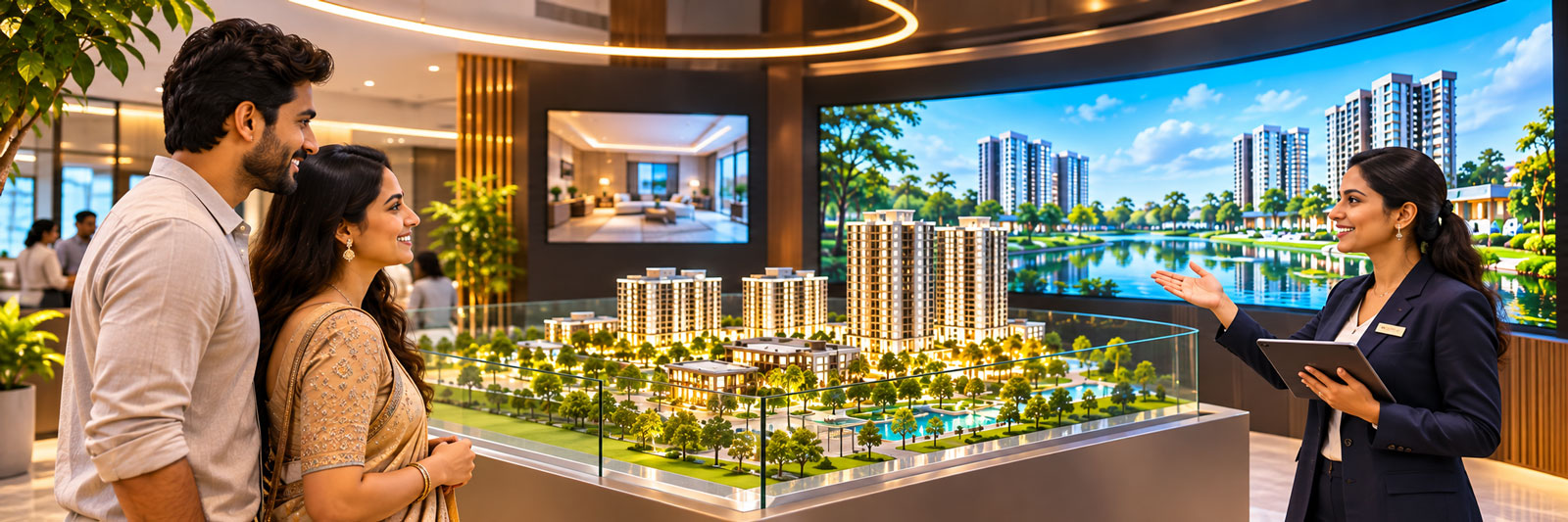
Buying a home has always required imagination.
A buyer looks at a brochure and imagines the view from the balcony. They study a masterplan and try to understand how far their home is from the clubhouse. They watch a walkthrough and picture what it might feel like to drive through the entrance, pass the landscaped gardens and finally arrive at their own front door.
But what if they did not have to imagine it?
The next generation of real estate sales galleries can allow buyers to experience a development before it is built.
At Showman Entertainment, we envision sales galleries moving beyond static displays, scale models and conventional walkthrough videos into immersive environments where projection, real-time 3D, motion, spatial audio, sensory effects and interactive technology work together.
The idea is simple:
Do not just show people where they could live. Let them experience arriving home.
A conventional sales gallery communicates information. An immersive sales gallery can create an experience.
Imagine entering a sales experience centre and stepping into a large projection environment. In front of you is a real golf cart.
You get in.
The estate gates appear ahead. They open, and the journey begins.
The cart takes you through tree-lined avenues, landscaped gardens and a lakeside boardwalk. You pass the clubhouse, pool, sports areas and wellness spaces. Eventually, you arrive outside a villa.
Then something unexpected happens.
The front door you see in the projected villa is actually a real door.
It opens.
You step out of the virtual estate and directly into a physical show villa.
This is the core thinking behind Showman’s Drive Into Your Home concept: transforming the property presentation into one continuous journey from the entrance of the development to the buyer’s potential home.
At the heart of the experience is an immersion cave.
The proposed environment measures approximately 40 × 40 × 30 ft, with four projected walls and a projected floor surrounding the visitors. The objective is to remove the visual boundaries of the room so that, from the golf cart, guests experience the environment around them rather than noticing the physical walls.
But projection is only one layer.
The golf cart itself can sit on a motion platform synchronised with the content. When the virtual vehicle accelerates, turns, slows or moves across different surfaces, physical movement supports what visitors see.
The projected floor creates the sensation of the road travelling beneath them.
Wind can simulate the breeze while driving through an avenue. Floral scents can accompany landscaped gardens. Cooler air can reinforce the feeling of approaching the lake. Surround audio places birdsong, water and other environmental sounds around the visitors.
For one hero moment, the experience can even move beyond the road.
The cart virtually lifts above the development, giving buyers an aerial view of the masterplan. Project phases, locations and other information can then be incorporated directly into the environment before the cart returns to ground level and continues towards the amenities and the buyer’s villa.
Instead of explaining a masterplan from above a table, the development can unfold around the buyer.
Real estate is rarely sold on the apartment or villa alone.
Buyers are also buying the morning walk, the landscaped avenue, the clubhouse, the view from the balcony, the pool, the children’s play area and the feeling of returning home.
The challenge is that many of these elements may not exist when sales begin.
An immersive sales gallery changes that.
Developers can take prospective buyers through the entire lifestyle of the development, including spaces that are still under construction.
A five-minute immersive journey, for example, could move from the entrance gate through landscaped avenues and gardens to a lakeside boardwalk. Buyers could then rise above the project to understand the masterplan before travelling past the clubhouse, pool, sports facilities and wellness areas and finally arriving at their villa.
The sales gallery therefore stops being a place where buyers are told about amenities.
It becomes a place where they can experience them.
One of the most powerful elements of the concept is the transition between digital and physical space.
At the end of the virtual journey, the cart approaches a projected villa facade. A physical entrance door is integrated precisely into the projection surface.
The cart stops.
The door opens, warm light appears from inside, and visitors walk directly through it.
One second they are inside a projected world.
The next, they are standing inside a real villa.
There is no need to stop the experience, walk into another room and begin another presentation. The virtual estate and physical show home become parts of the same story.
That transition can also become a natural shareable moment—something visitors photograph or film because it feels unexpected.
The experience does not have to end once buyers enter the physical home.
Showman’s concept extends immersion into the villa itself through movement-responsive technology.
Tracking and depth-sensing systems can detect where visitors are within different rooms. Their movement can then trigger lighting, narration, projected content and environmental changes.
Enter the living room, for example, and the windows can function as projection surfaces. As visitors approach them, the outside environment could transition from morning to sunset.
Walk into the kitchen or dining area, and lighting or narration can highlight particular features.
A finish-selection area could use projection mapping to transform otherwise neutral walls and floors. Buyers could switch between marble, wood, colours or other finishes without physically constructing multiple versions of the same room.
Finally, they could walk towards the bedroom balcony and watch the development transition into night, with the lake and surrounding estate illuminated in front of them.
The model home is no longer static.
It responds to the person exploring it.
One of the biggest advantages of this approach is that the physical experience centre does not necessarily have to be rebuilt every time the development changes.
The proposed Showman system uses real-time 3D content, allowing the digital environment to remain editable.
A developer could update project phases, unit types, landscaping or seasonal appearances within the content rather than reconstructing the entire physical experience.
The same immersive infrastructure can therefore support evolving sales requirements.
Today, visitors could experience one phase of the development.
Later, the content could be updated to introduce another phase or unit type.
The environment could even adopt different visual treatments for a launch, festive period or special campaign.
This makes the installation more than a one-campaign attraction. It can become a long-term experiential sales asset.
For developers, the initial infrastructure is a one-time investment in the immersive environment and its core technology, while future experiences can be refreshed primarily through content and programming, subject to the extent of the required changes.
The same principle also opens possibilities beyond a single development.
Showman’s concept can be installed within an on-site sales gallery, but it can also be adapted as a city-centre experience for presenting projects away from the actual construction site.
That changes the role of the sales gallery itself.
Instead of requiring every buyer to travel to an unfinished development, a developer could potentially bring the experience closer to the buyer.
And because the content is digital and built for modification, the experience can evolve alongside the project.
For the buyer, the technology should almost disappear.
They should simply feel that they are travelling through the estate.
Behind that experience, however, multiple systems work together: multi-surface laser projection, floor projection, real-time 3D rendering, motion simulation, spatial audio, wind, scent and temperature effects, tracking sensors, lighting and centralised show control.
Showman’s approach brings these technologies togb
Show control synchronises the different layers so that the visual journey, vehicle movement, environmental effects, sound, lighting and even doors can respond at precisely the right moment.
The technology exists to support the story.
And the story is the buyer’s journey home.
Brochures, renders, walkthrough films and scale models will continue to have a role in real estate marketing.
But they all ask buyers to observe a future development from the outside.
Immersive sales galleries offer another possibility: put the buyer inside that future.
Let them drive through the gate.
Let them experience the gardens.
Let them see the lake.
Let them understand the masterplan from above.
Let them arrive at their villa.
And then let them open the door and walk inside.
For developers, this creates a sales environment that can showcase an entire project before it physically exists while remaining adaptable as the development evolves.
For buyers, it transforms an abstract decision into something far more tangible.
Because the future of the real estate sales gallery may not be about showing people more.
It may be about letting them experience more.
Showman Entertainment creates immersive experiences combining projection, real-time visualisation, motion, interactive technology, sensory effects and experiential storytelling to transform how audiences engage with spaces, destinations and brands.


