
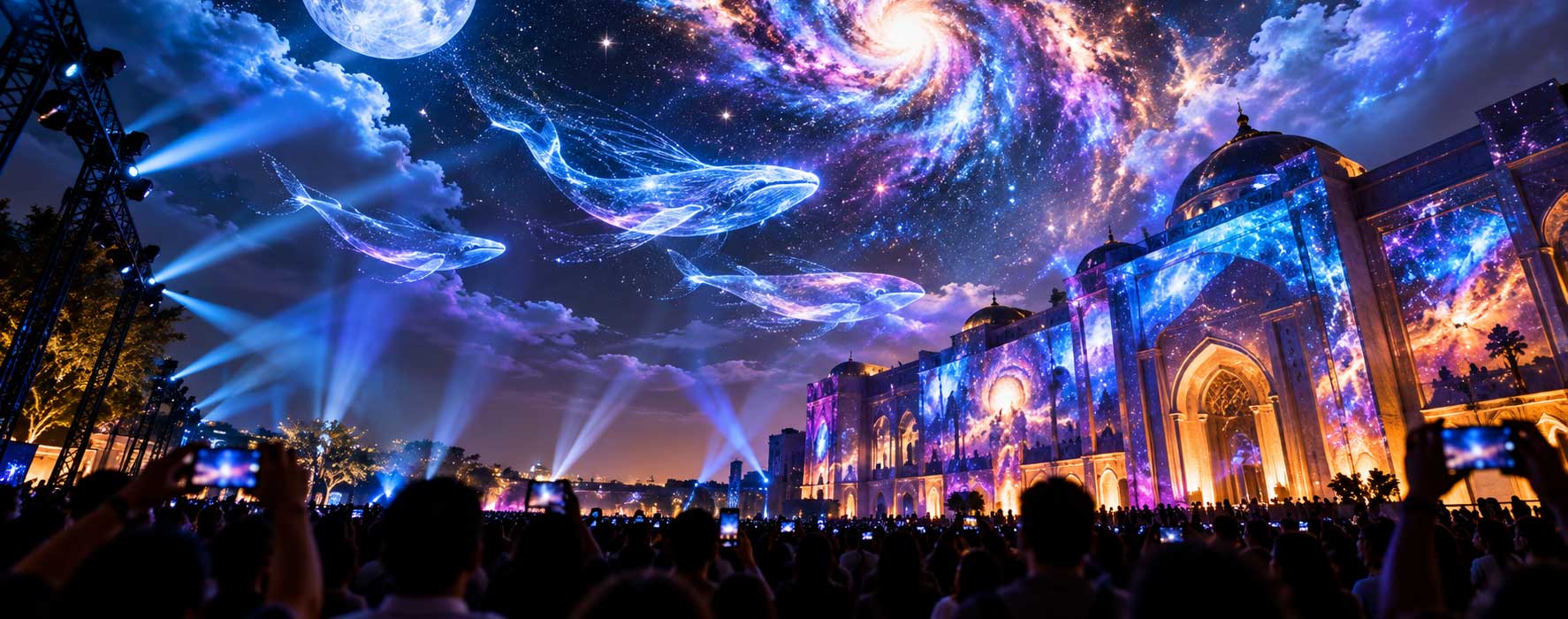
The evolution of experiential technology has continuously pushed creative storytelling beyond conventional screens and stages. Projection mapping transformed buildings into dynamic visual canvases. Laser shows brought light and movement into open spaces. Drone shows introduced coordinated storytelling across the night sky.
Now, sky projection is opening another creative possibility: using the atmosphere, mist, haze and specially created aerial surfaces to produce visual experiences that appear to exist above the audience.
For large public events, tourism destinations, festivals, cultural celebrations and landmark experiences, the sky itself can become part of the show.
Sky projection broadly refers to projection and visual technologies designed to create imagery that is perceived in the air or against an atmospheric or aerial medium.
Unlike conventional projection, where content is displayed on a building, screen or physical structure, sky-based visual experiences can use carefully engineered combinations of high-powered projection, lasers, controlled haze, mist, water particles, lighting and other show technologies.
Depending on the environment and technical configuration, the experience can range from abstract beams and moving patterns to large-scale visual compositions integrated with the surrounding architecture and landscape.
Rather than thinking of the sky as an empty background, immersive show designers can treat it as another layer of the storytelling environment.
Traditional projection mapping begins with a physical surface. A monument, building façade, stage, sculpture or installation becomes the canvas.
Sky projection changes this relationship.
The visual experience can extend beyond the structure itself and into the space surrounding it.
Imagine a heritage monument illuminated through architectural projection mapping while beams, atmospheric visuals and aerial effects continue the story above it. A historical sequence unfolding across the façade could transition into dramatic light formations overhead.
Instead of watching content contained within a rectangular screen, audiences experience a three-dimensional visual environment.
This creates an opportunity to combine multiple technologies, including:
The result is not simply a projection. It becomes a coordinated multimedia spectacle.
One of the strongest applications for sky projection concepts is large outdoor events.
Government celebrations, national festivals, destination launches, cultural programmes, corporate events and major public gatherings often need experiences that can command attention across large spaces.
The vertical dimension of the sky dramatically increases the perceived scale of an event.
A conventional stage directs attention toward one location. A spatial show can surround the audience with light, sound and movement.
For event organisers, this creates opportunities for dramatic opening sequences, countdown moments, brand reveals, ceremonial presentations and grand finales.
India’s monuments, temples, forts and public landmarks provide extraordinary opportunities for immersive storytelling.
Projection mapping can reveal stories directly on architectural surfaces while complementary sky effects can extend those narratives into the surrounding environment.
A historical character appearing across a monument could be accompanied by symbolic imagery above the structure. Celestial motifs could support stories connected to mythology. Abstract patterns inspired by traditional art could transition from architectural projection into laser and atmospheric effects.
Combined with music, narration and spatial sound, these technologies can transform a heritage location into an immersive storytelling destination.
The objective is not simply to make a landmark brighter or more colourful. Technology should support the story, architecture and cultural significance of the location.
Destination experiences increasingly need to give visitors a reason to stay beyond daylight hours.
Night-time attractions can help tourism destinations create an entirely different identity after sunset.
Sky projection concepts combined with projection mapping, sound and light shows, fountains, lasers and immersive technologies can contribute to recurring evening attractions at:
Instead of creating an experience that exists only during a festival or special occasion, the technology can become part of a permanent or recurring attraction.
This creates possibilities for destination storytelling, where the history, mythology, culture or identity of a location becomes an immersive nighttime experience.
The most powerful future applications of sky projection are unlikely to depend on one technology alone.
Imagine entering a large public space after sunset.
Architectural projection begins transforming a landmark in front of the audience. Spatial audio introduces the story. Lasers extend visual elements beyond the structure. Controlled atmospheric effects create depth above the venue. Water-screen projection introduces floating imagery at ground level. Musical fountains respond to the soundtrack.
The entire environment becomes part of the narrative.
This is where immersive technology is moving: from individual visual effects towards integrated experiences.
Every technology has a specific role, but the audience should experience them as one seamless show.
Large-scale outdoor projection is significantly more complex than simply positioning a projector toward the sky.
Environmental conditions, ambient light, projection distance, atmospheric density, viewing angles, weather, aviation considerations, local permissions, equipment specifications and audience safety can all influence what is technically achievable.
Content must also be designed specifically for the environment.
A concept that looks impressive on a computer screen may behave very differently when projected across a large outdoor space.
Successful execution therefore requires close coordination between creative design, projection engineering, show control, lighting, audio and on-ground technical teams.
The technology should always be selected according to the site and desired experience rather than forcing a particular effect into an unsuitable environment.
Experiential technology is steadily removing the boundaries between content and physical space.
Walls became projection surfaces. Floors and ceilings became part of immersive rooms. Water became a screen. Buildings became animated storytelling canvases.
Now, the space above audiences offers another creative dimension.
Sky projection and atmospheric visual technologies can help designers think beyond traditional screens and create experiences that feel larger, deeper and more spatial.
For governments, tourism boards, event organisers, cultural institutions, brands and destination developers, this represents an opportunity to create experiences that audiences do not simply watch — but physically stand within.
At Showman Entertainment, we explore how technologies such as 3D projection mapping, sound and light shows, laser shows, water-screen projection, musical fountains, immersive projection and multi-sensory technologies can work together to transform spaces into experiences.
From heritage storytelling and tourism attractions to corporate spectacles and large public events, our approach begins with the environment and the story that needs to be told.
Because sometimes the most powerful canvas isn’t a screen or a building.
It’s the entire space around us — and even the sky above.


