
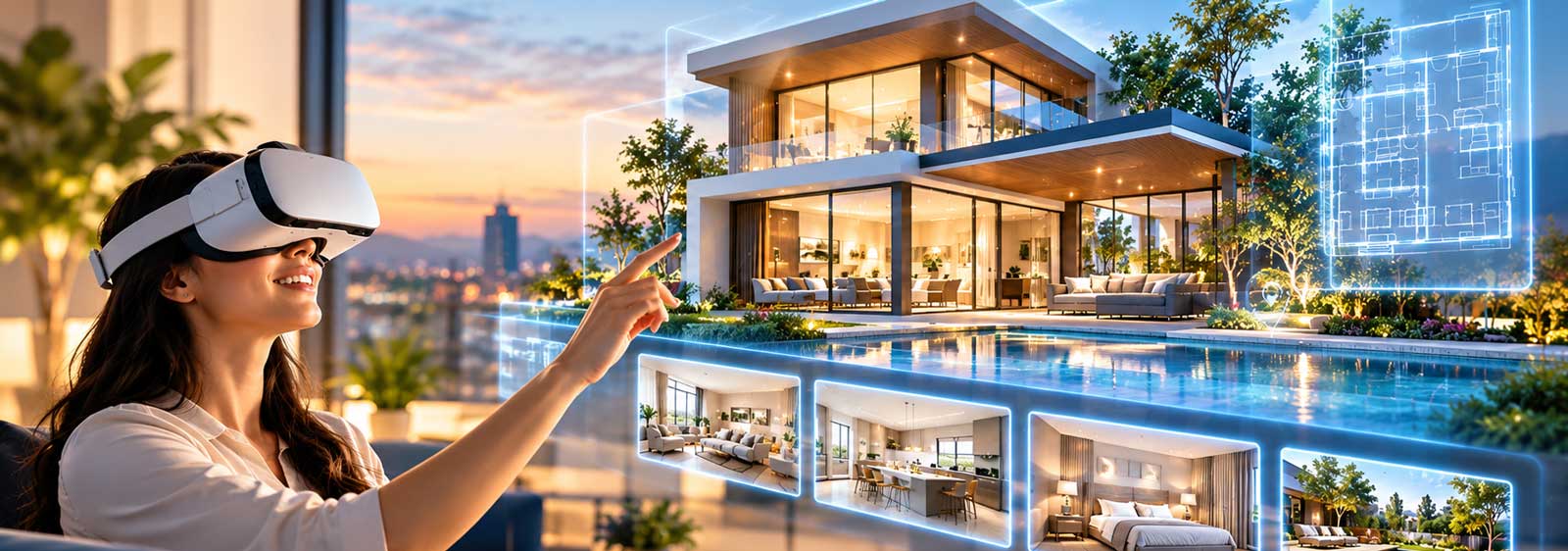
Buying a home has always required imagination.
A buyer looks at a floor plan and imagines the rooms. They watch a walkthrough and imagine moving through the property. They study a masterplan and try to picture the roads, landscapes, clubhouse, lake and neighbourhood that may still be under construction.
But what if they did not have to imagine any of it?
What if they could get into a vehicle, drive through the future development, explore its amenities, arrive outside their chosen villa and then physically walk through its front door?
That is where the next generation of immersive real estate experience centres could be headed.
Traditional real estate sales galleries are designed around representations of a future development: architectural models, renders, brochures, display units and digital walkthroughs.
Immersive technology changes the relationship between the buyer and that representation.
Instead of standing outside the project and looking at it, the buyer can be placed inside the story of the development.
Imagine entering a sales experience centre and boarding a real golf cart. Instead of driving outdoors, the vehicle sits within a large-scale projection environment where the walls and floor become the future estate.
The gates open.
The cart begins moving.
Trees appear overhead as you travel down an avenue. You pass landscaped gardens, move alongside a lake, approach the clubhouse and see recreational spaces come alive around you.
Wind, spatial audio, environmental effects and vehicle motion reinforce what is happening visually, turning what would ordinarily be an architectural walkthrough into a multi-sensory journey.
The objective is no longer simply to communicate what the project contains. It is to communicate what living there could feel like.
The sense of presence becomes considerably stronger when physical and digital environments work together.
A real golf cart, for example, gives visitors a physical reference point throughout the experience. Motion can be synchronised with real-time 3D visuals so that acceleration, turns, braking and changes in terrain correspond with what visitors see around them.
Large-scale projection across the surrounding walls and floor can remove the visual boundaries of the room, while technologies such as real-time rendering allow perspective and content to remain coordinated throughout the experience.
Additional environmental layers can make individual locations feel different.
A landscaped avenue could introduce a light breeze and floral fragrance. A lakeside stretch could become cooler, accompanied by water ambience and reflections moving beneath the vehicle. Surround audio could position birds, water, music and environmental sounds throughout the space.
Instead of explaining the estate amenity by amenity, the experience connects them into one continuous journey.
Perhaps the most powerful moment comes at the end of the ride.
The vehicle approaches the buyer’s future villa.
The projected façade appears ahead. The cart slows down and stops outside the entrance.
But the front door is not projected.
It is real.
The door opens, warm light appears from inside and visitors physically step out of the immersive environment and into a full-scale villa.
In a matter of seconds, the experience moves from a digitally created future estate to a tangible home.
This transition between virtual and physical environments can create something conventional property presentations struggle to achieve: continuity.
The buyer has not simply watched the journey to the property. They have arrived home.
The experience does not necessarily have to end when visitors enter the villa.
Tracking technologies and environmental control systems can make the physical home itself interactive.
As visitors enter the living room, lights could gradually respond to their presence. Digital windows could transition between morning, sunset and night views. Moving towards a particular area could trigger information about features or amenities.
Projection mapping could also transform interior finishes in real time.
A buyer considering different flooring, wall treatments, marble finishes or colour combinations could potentially switch between options without rebuilding the display villa for every configuration.
In the bedroom, visitors could walk towards the balcony and see the future estate beyond it. Day turns into night. Buildings illuminate around the lake. Landscape lighting comes alive.
The home becomes more than a display unit.
It becomes a responsive storytelling environment.
One of the biggest challenges in pre-construction real estate is that some of the project’s strongest selling points may still exist only on paper.
The clubhouse may not be finished. Landscaping may not have matured. The lakefront may still be under development. Entire phases of a township may not yet exist.
Immersive environments can help bridge that gap.
Real-time 3D content can visualise the development as intended while allowing visitors to experience relationships between different spaces: the distance from their home to the clubhouse, the character of the central avenue, the lakeside environment or the scale of the overall masterplan.
Because the environment is digital, it can also evolve alongside the development. Different phases, unit types, landscapes or seasonal experiences can be introduced without rebuilding the entire physical experience centre.
Creating this kind of experience requires multiple systems working together: large-format projection, real-time 3D rendering, motion platforms, immersive audio, environmental effects, tracking sensors, projection mapping and automated show control.
But the buyer should not be thinking about any of them.
They should be thinking:
“This is what it could feel like to live here.”
That is the difference between installing technology and designing an experience.
Every element — from the movement of the vehicle to a breeze along an avenue or the moment a physical door opens — needs to contribute to the same narrative.
For flagship residential developments, luxury communities and large-scale townships, experience centres have the potential to become far more than spaces for viewing models and discussing pricing.
They can become destinations in their own right.
A carefully designed journey can take a prospective buyer from introduction to exploration, from exploration to emotional connection, and finally from that experience directly into a conversation about a specific home.
Instead of asking buyers to imagine their future from a brochure, developers can give them a glimpse of that future at life size.
At Showman Entertainment, we see immersive technology not simply as a way to display real estate, but as a way to build experiences around it. By bringing together projection, real-time visualisation, motion, spatial audio, sensory effects, tracking and physical environments, the sales gallery can become part of the property’s story itself.
Because sometimes, the most compelling way to show someone their future home is to let them drive right up to the front door.


