
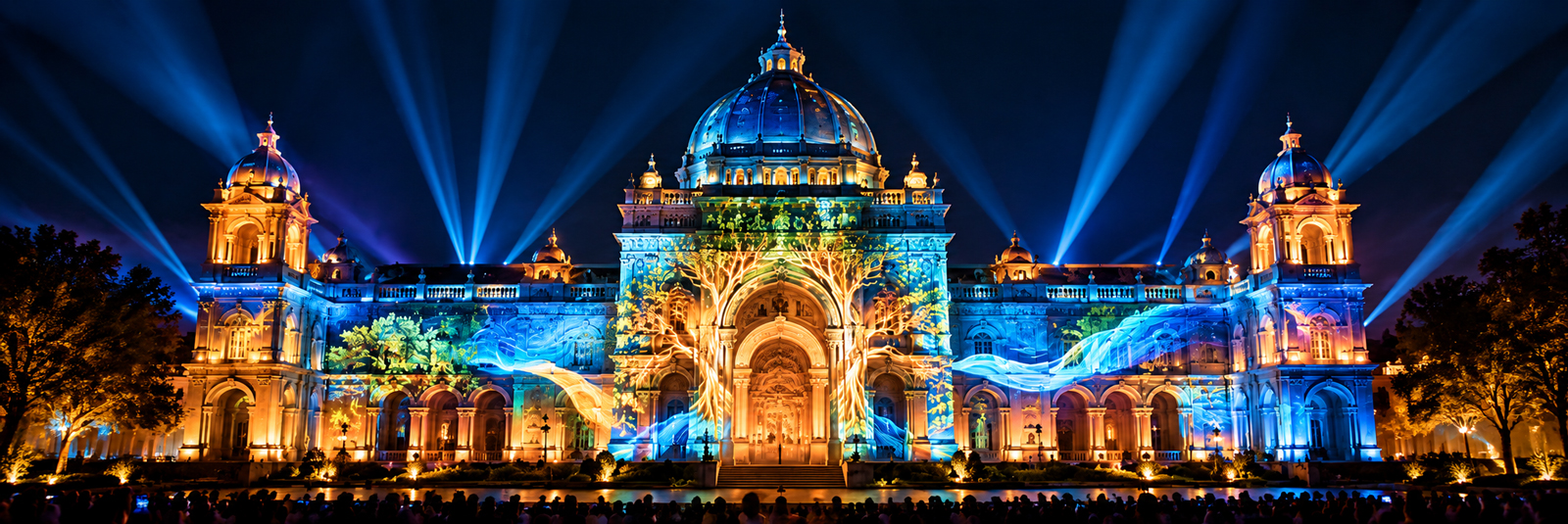
What happens when light does more than illuminate, sound does more than accompany, and a screen becomes an entire environment? The result is an experience that engages audiences, evokes emotion and transforms the way people interact with a space.
Today, immersive experiences are no longer defined by a single technology. They are created by bringing together multiple technologies that complement one another, turning physical spaces into dynamic storytelling environments. From monumental architectural projections and musical fountains to immersive museums and experiential spaces for real estate, the possibilities expand when technology is designed to work as one.
At Showman Entertainment, we bring together creative vision, technical expertise and multiple visual technologies to transform spaces into memorable experiences.
Every technology has its own strength. Projection mapping can transform an architectural surface into a storytelling canvas. Laser lighting introduces precision, movement and visual drama. Spatial audio creates atmosphere and directs attention, while water screens offer a distinctive medium for projected visuals. Interactive systems can further bring audiences into the immersive experience.
When these elements are integrated thoughtfully, they create something that no individual technology could achieve on its own.
For instance, a sound and light show can combine architectural projection mapping, synchronised lighting, lasers, music and narration to bring history to life. A musical fountain can coordinate water jets, coloured lighting, video and music into a unified performance. An immersive experience exhibition can combine panoramic projections, surround sound and carefully designed environmental effects to make visitors feel as though they have stepped into another world.
The objective is not simply to use more technology. It is to make every element contribute to a single, coherent experience.
Projection mapping transforms buildings, monuments and other physical structures into large-scale visual canvases. By adapting content to the contours and features of a surface, it can make architecture appear to move, transform or tell a story.
When combined with architectural lighting, the experience gains depth, contrast and dimension. Lighting can highlight physical features while projected visuals create movement and narrative, allowing the structure itself to become part of the performance.
This combination is particularly effective for government installations, cultural landmarks, public celebrations and destination experiences.
Visual storytelling becomes more compelling when audiences can hear and feel the rhythm of what they see. Synchronising music, narration, lighting effects, lasers and projections creates a multisensory performance in which every element supports the narrative.
A change in music can trigger a shift in lighting. A laser sequence can emphasise a dramatic moment. Narration can guide the audience through a historical event, while projections give that story a visual dimension.
The result is a carefully choreographed experience rather than a collection of disconnected effects.
Water introduces movement, texture and a distinctive visual dimension to immersive installations. Musical fountains combine choreographed water jets, lighting and music, while water screen projection uses a fine curtain of water as a surface for projected imagery.
Integrating these technologies with sound, lasers and architectural projections can create a layered spectacle that unfolds across multiple surfaces.
For tourism destinations, public spaces, cultural attractions and large-scale events, these combinations can turn an ordinary viewing area into a destination in its own right.
Immersive environments take multisensory storytelling beyond conventional screens. Using 360-degree projection, panoramic displays, spatial audio and interactive content, designers can create experiences that surround visitors with visuals and sound.
Additional elements such as controlled airflow, fragrance and motion-synchronised visuals can introduce further sensory dimensions where appropriate.
In museums, this approach can help visitors explore historical periods, ecosystems or works of art. In real estate, immersive experience rooms can help prospective buyers understand a development’s spatial layout, ambience and surroundings before construction is complete.
By combining digital content with the physical environment, these installations make complex ideas easier to experience and understand.
Immersive technology becomes even more engaging when audiences can influence what happens around them.
Touchscreens, motion-responsive systems, interactive projections and digital visualisation tools can allow visitors to explore content at their own pace. In real estate sales environments, interactive property displays can help buyers navigate floor plans, compare configurations and explore project amenities.
When integrated with immersive projection or panoramic visualisation, these tools create a more participatory experience, replacing passive viewing with active exploration.
The value of technology integration becomes most apparent when it is applied to real spaces and real stories.
Showman’s work on the Valluvar Kottam Sound and Light Show demonstrates how visual storytelling can transform a cultural landmark into an engaging public experience. By combining storytelling with audiovisual presentation, such installations can create new ways for audiences to connect with heritage and history.
The project received a Silver Award at the EEMA Awards 2026 in the Government Show of the Year – Installation Project category, recognising the work behind the installation.
Beyond cultural landmarks, integrated immersive technologies offer opportunities across museums, tourism destinations, public infrastructure, live events and real estate. Each application calls for a different combination of technologies, shaped by the space, the audience and the story that needs to be communicated.
For Showman Entertainment, the starting point is not a technology catalogue. It is the experience the project needs to deliver.
Combining technologies is not as simple as installing multiple systems in one location. Each component must operate in coordination with the others.
Content must be designed for the physical environment. Projection and lighting need to work together without compromising visibility. Audio must remain clear across the audience area. Timing, control systems, equipment placement and environmental conditions all influence the final result.
Most importantly, the technologies must serve a clear purpose. An installation with too many competing effects can overwhelm audiences rather than engage them.
Successful immersive experiences depend on the relationship between creative direction, content development, engineering, system integration and operational planning. When these disciplines work together from the beginning, technology becomes an integral part of the storytelling rather than an addition to it.
As audiences increasingly seek experiences that are interactive, memorable and emotionally engaging, the future of experiential design lies in bringing technologies together in more meaningful ways.
Advances in real-time content, interactive systems, spatial visualisation and intelligent control are opening new possibilities for the way spaces can communicate. The next generation of installations will not simply display information or deliver entertainment. They will respond to their environments, guide audience journeys and create experiences tailored to the purpose of each space.
For brands, developers, cultural institutions and public-sector organisations, this presents an opportunity to rethink how physical environments can engage people.
The most memorable experiences are rarely the result of one technology working alone. They emerge when visuals, sound, light, movement and interaction come together with a clear creative purpose.
At Showman, we bring together immersive visual technologies and experiential design to create installations that transform spaces and connect with audiences. From projection mapping and sound and light shows to musical fountains, water screen projections and immersive environments, our focus is on making technology work together to deliver a unified experience.
Because the real impact of technology is not measured by how much of it is used, but by what people experience when it all comes together.
Planning an immersive installation or transforming a physical space into an experiential destination? Explore how Showman can help bring your vision to life. Get a free quote.


