
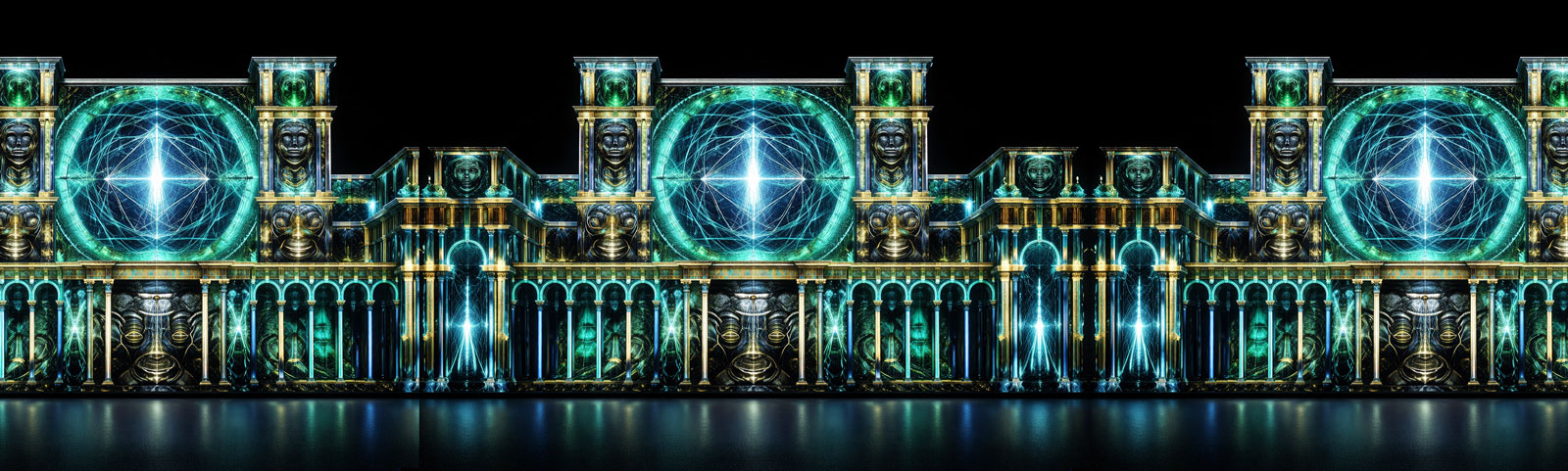
3D projection mapping has rapidly evolved from a niche visual technique into a mainstream spectacle used across events, architecture, entertainment, and brand experiences. From transforming heritage monuments into storytelling canvases to creating immersive stage environments, 3D projection mapping blends art, engineering, and technology in a way few mediums can.
At its core, projection mapping technology allows visuals to be projected onto irregular surfaces like buildings, objects, or landscapes, turning them into dynamic, animated displays. But how exactly does this work?
This guide breaks down the process, technology, and execution behind India’s top entertainment company- Showman Entertainment’s 3D projection mapping, especially relevant for brands, governments, and event planners exploring high-impact visual storytelling.
3D projection mapping (also called video mapping or spatial augmented reality) is a technique that projects digital content onto physical surfaces in a way that aligns perfectly with their geometry.
Unlike traditional projection on flat screens, 3D mapping:
This is why buildings appear to crumble, rotate, or morph during projection mapping shows.
The process behind 3D projection mapping involves a combination of hardware precision, software modelling, and creative design.
Surface Analysis & Mapping
The first step is understanding the projection surface.
The goal is to create a digital replica (3D model) of the real-world object.
3D Modelling & Content Alignment
Once the surface is digitised:
This ensures that every window, pillar, edge, and contour is accounted for and animations align perfectly with the physical structure. For example: A column on a building can appear to “break apart” because the animation is mapped exactly to its position.
Content Creation & Animation
This is where storytelling meets technology.
Creative teams develop:
Content is tailored to surface geometry, viewing angles and event theme or brand message.
Some common styles include architectural illusion (buildings collapsing, expanding), cultural storytelling (heritage narratives), product showcases (interactive reveals).
Projection Warping & Calibration
Projection mapping software is used to align visuals with the real-world surface.
Key functions:
Calibration is critical as small misalignments can break the illusion.
Hardware Setup: Projectors & Media Servers
The physical setup determines the scale and clarity of the experience.
High-Lumen Projectors
Media Servers
Projection Angles
Carefully positioned to avoid shadows, maintain clarity and cover the entire surface.
Synchronisation & Execution
For large events that Showman Entertainment organises, our projection mapping is synchronised with sound design, lighting systems, laser shows and live performances.
This creates a fully immersive, multi-sensory experience. In high-end productions, everything is time-coded to ensure precision.
Showman Entertainment’s 3D projection mapping relies on a robust ecosystem of tools and technologies that work together to deliver seamless visual experiences. 3D modelling software such as Blender, Cinema 4D, and Autodesk Maya is used to create accurate digital replicas of physical surfaces, forming the foundation of projection mapping workflows. These models are then enhanced using real-time rendering engines like Unreal Engine and Unity, which enable dynamic, interactive, and high-quality visual outputs.
For precise alignment, specialised projection mapping software such as MadMapper and Resolume Arena ensures pixel-perfect calibration through warping and masking techniques. Additionally, edge blending technology allows multiple projectors to function as a single, seamless display, which is critical for large-scale installations, while advanced motion tracking systems introduce interactivity by responding to real-time inputs like movement and gestures, making 3D projection mapping technology more immersive and engaging for audiences.
Architectural Projection Mapping
Stage & Event Mapping
Object Mapping
Immersive Environment Mapping
High Visual Impact
Transforms familiar structures into something unexpected and memorable.
Storytelling at Scale
Ideal for:
Non-Intrusive Installation
No permanent structural changes required—perfect for heritage sites.
Shareability
Highly photogenic and video-friendly, boosting social media reach.
Projection mapping is rapidly evolving, driven by advancements in artificial intelligence, real-time rendering, and immersive technologies. AI-powered and real-time content generation is enabling dynamic visuals that can adapt instantly to live inputs, making experiences more responsive and personalised. At the same time, interactive projection mapping is transforming passive viewing into audience-controlled experiences, where gestures, movement, or mobile inputs influence the visuals in real time.
The integration of AR and VR is further pushing boundaries, creating hybrid immersive environments that blend physical and digital worlds seamlessly. Additionally, the industry is moving towards sustainable projection mapping technology, with energy-efficient projectors and optimised systems reducing power consumption without compromising visual impact—making large-scale installations more environmentally responsible.
Executing a seamless projection mapping show requires:
Experienced teams like Showman bring together design, engineering, and production expertise to deliver large-scale, high-impact visual experiences—whether for government projects, brand activations, or landmark events.
3D projection mapping is not just a visual technique—it’s a convergence of technology, creativity, and storytelling. By turning any surface into a dynamic canvas, it enables organisations to engage audiences in ways that are immersive, memorable, and scalable.
As demand for experiential content continues to grow, projection mapping technology is set to become a cornerstone of modern visual communication—especially in markets like India where heritage, infrastructure, and storytelling intersect at scale.
To get a free quote, contact us.


